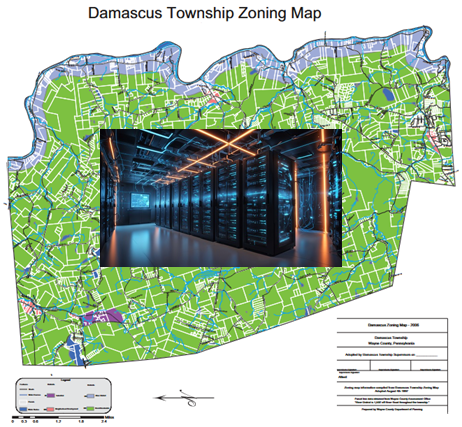
Damascus Township Draft Data Center Zoning Ordinance is Available
September 18, 2026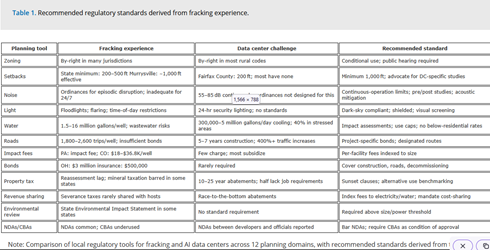
From the Journal of the American Planning Association, by Austin Zwick, August 24, 2026:
Read the full article and download it as a pdf
Abstract
Artificial intelligence (AI) data centers impose the same externalities on local communities that hydraulic fracturing did a decade ago: massive water consumption, continuous noise, construction road damage, thin permanent employment, and fiscal mismatches that leave municipalities bearing infrastructure costs while states capture revenue through tax abatements. Drawing on field work with municipal planners across five Marcellus Shale states, I argue in this Viewpoint that planners should treat data centers as heavy industrial uses and apply the targeted regulatory tools that fracking communities developed through hard experience. Outright bans invite state preemption; targeted regulation has proved durable. The analogy has limits, but the governance playbook transfers.
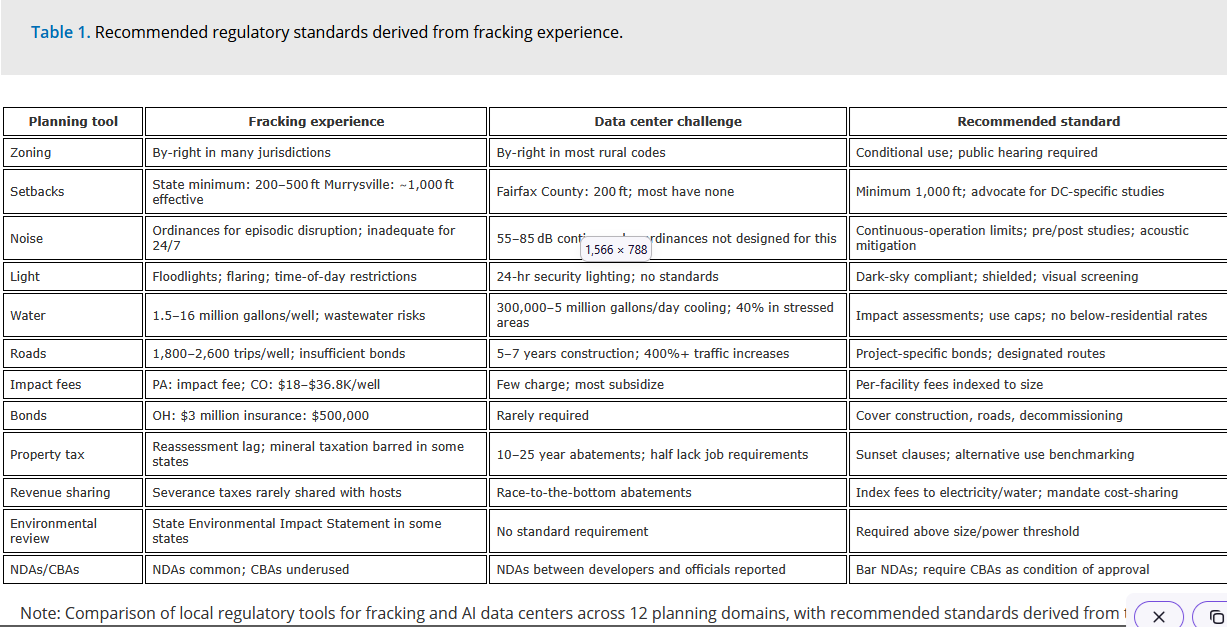
Table 1 shows the types of issues that communities face. These issues are discussed in this paper and recommended regulatory standards, derived from fracking experience, are proposed.
Conclusion
The broader question of how local government grapples with emerging industries that impose locally concentrated externalities is a recurring challenge planners will face repeatedly. However, a playbook already exists; it just needs to be invoked.
Four lessons transfer from the fracking experience to data center governance. First, planners must act before proposals arrive. Second, outright bans are legally fragile, whereas targeted regulations (e.g., conditional use review, setbacks, noise standards, road use agreements, community benefits agreements) are sturdy. Third, road damage and water supply are the externalities local governments can least afford to absorb and should prioritize, ensuring there are provisions to cover those costs. Finally, disadvantaged communities will bear the heaviest burden unless equity is built into the regulatory framework from the start.
The analogy between fracking and data centers has limits, and the data center literature is still emerging. Future research should include (a) documenting how data center host communities are responding to the regulatory challenge; (b) assessing the longitudinal fiscal health of host municipalities under different abatement regimes; and (c) evaluating which planning tools (conditional use review, setbacks, impact fees, community benefits agreements) produce measurable improvements in community outcomes.
The show will always head to the next town; the question is whether planners will be ready when it arrives.