Shale Gas and Public Health Conference 2026
January 24, 2026
Fighting Back Against ICE Detention Facilities Locally and Beyond
February 20, 2026What Rights Do Our Rivers Have?
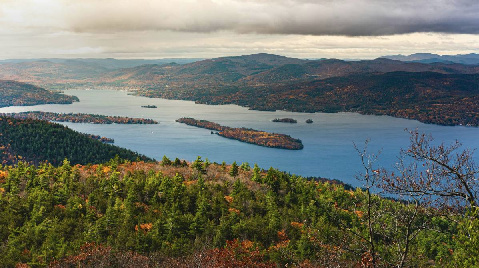
The Hudson River near Saratoga Springs, NY. Photo credit: Harry Gillen.
Ron Hine is a founding member of Fund for a Better Waterfront (FBW) and currently serves as its Executive Director. He is also a DCS Board member, a farmer in Damascus Township, PA, and a ceramic artist with a long career based in Hoboken, NJ. This article was originally published on FBW.
For some 30 years, beginning in the late 1940s, the General Electric Corporation dumped polychlorinated biphenyls (PCBs) into the Hudson River from two electrical capacitor manufacturing plants located at Hudson Falls and Fort Edward, New York. The volume of PCBs that fouled a 200 mile stretch of the river down to Troy, New York was estimated between 100 and 650 tons. The PCB compounds attached to soils and river sediments, accumulating in fish, wildlife and humans. In 1984, the U.S. Environmental Protection Agency (EPA) designated this portion of the Hudson River as a Superfund Site, among the largest in the country.
General Electric’s abuse of the river was notorious but, of course, there were many other sources of contamination from industrial chemicals, sewage and urban runoff. The laws of our land grant rights to people and to corporations. What if the Hudson and other American waterways had rights as well?
The British nature writer Robert Macfarlane explored this idea in his 2025 book, Is a River Alive?
“There are few things as powerful as an idea whose time has come. Over the past twenty years, energized by ecological emergency, the young Rights of Nature movement has repeatedly inspired new forms of future dreaming, and unsettled long-held orthodoxies by appealing to imagination as much as to law. Case after case has been brought worldwide to test the anthropocentric foundations of existing legislation — and the drive to recognize the lives, rights and voices of rivers, mountains and forests has lit up activists, lawmakers, politicians, artists and campaigners. Much of the trailblazing has been done by what the Mexican activist Gustavo Esteva called ‘those from below’: ‘grassroots groups. . . which transform the world in the here and now,’ chiefly local people and Indigenous communities mobilized by shared experiences of threat and loss to their landscapes.”
In Part I of his book, Macfarlane describes his trip to the cloud-forest of northern Ecuador, Los Cedros. In 2008, Ecuador became the first country in the world to rewrite its constitution to embrace the rights of nature.
Twenty to thirty years ago, Ecuador underwent a period of political turmoil. After seven presidents came and went over a nine year span, Rafael Correa was elected President in 2006 promising a new constitution and the empowerment of marginalized groups. Development was to be reoriented around the concept from Andean indigenous cultures of “buen vivir” where people are considered stewards of the earth and its resources and individual rights subjugated to that of communities and nature.
Macfarland writes that Ecuador wrote into “its constitution that Mother Earth, known in that country as Pachamama, had rights to maintain and regenerate life cycles. As a result, the state was obligated to prevent ecosystem destruction and species extinction. The basis for the rights of nature was the view of indigenous cultures that humans and nature are interconnected.”
After a vigorous and lengthy participatory process, the constitution was drafted. In 2008, a national referendum ratified the document with the approval of 64% of the voters. In addition to expanded rights for the population, the constitution enshrined the rights of nature and granted people and communities standing to defend those rights.
The Ecuadorian courts have produced a globally significant body of case law based on the constitution’s rights of nature provisions. In a 2011 case, a provincial court granted an injunction against a road-widening project that dumped debris into the Vilcabamba River. The plaintiffs, who were not property owners, sued on behalf of the river. The court ruled that this government project violated the rights of the river to maintain its natural course and cycles.
In a 2015 mangrove-reserve case, Ecuador’s Constitutional Court determined that the Ministry of Environment, and thus other state agencies, could bring cases to represent the rights of nature, overturning a lower-court decision that had failed to do so.
In 2021, the Constitutional Court issued a landmark judgment revoking permits for mining operations in the biodiverse, 17,000 acre Los Cedros cloud forest. The Court found that nature’s rights extended throughout the entire national territory and were not relegated solely to areas designated for protection. The court decision also found that environmental codes needed to be updated to be compatible with the constitutional protections. This case is considered precedent setting, one of most significant rulings upholding the rights of nature, influencing thinking around the globe.
Some court rulings have gone the other way, favoring economic development over the rights of nature. The experience of Ecuador in enforcing the environmental language of its Constitution has exposed the many challenges faced by the rights of nature movement.
A cloud forest is a tropical or subtropical mountain forest covered in constant or frequent fog and cloud cover, keeping the air cool and moist. These high-elevation environments, considered biodiversity hotspots, host a diverse array of plant, animal and fungal life.
The rights of nature movement has made progress elsewhere around the world as follows:
- Bolivia: Passed laws in 2010 and 2012 recognizing nature’s legal rights.
- Panama: Enacted legislation in 2022 recognizing the rights of nature.
- Uganda: Amended environmental legislation in 2019 to recognize nature’s rights.
- New Zealand: Granted legal personhood to the Whanganui River (2017), Te Urewera (2014), and Mt. Taranaki (2025).
- Colombia: Courts recognized the Atrato River and the Amazon rainforest as holding rights.
- India: Courts have recognized the rights of the Ganges and Yamuna rivers.
- Spain: Recognized legal rights for the Mar Menor lagoon.
- Pennsylvania: Tamaqua Borough was the first U.S. community to pass a rights-of-nature law in 2006. (Over three dozen communities in the U.S. have passed similar laws.)
- Tribal Nations: The Ponca Nation (Oklahoma), White Earth Band of Ojibwe (Minnesota), and others have passed tribal laws recognizing the rights of nature.
- Mexico: Added rights of nature to the constitutions of Mexico City, Guerrero, Oaxaca, and Colima.
- Brazil: Municipalities like Bonito and Paudalho have adopted rights of nature laws.
Some trace the rights of nature movement back to Christopher D. Stone who wrote a 1972 article, “Should Trees Have Standing? – Towards Legal Rights for Natural Objects,” originally published as a law review article that later became a book. In the article, he states, “I am quite seriously proposing that we give legal rights to forests, oceans, rivers and other so-called ‘natural objects’ in the environment — indeed, to the natural environment as a whole.” Stone put forth his ideas just as the modern U.S. environmental movement began.
Related Links
Around the world, swimming has returned to local waterways. What about Hoboken?
The Hudson River fishermen and the boat that began the Riverkeeper movement
Noelle Thurlow says Hoboken Cove is prime candidate for habitat restoration
Noelle Thurlow explains why the Hoboken Cove is so unique